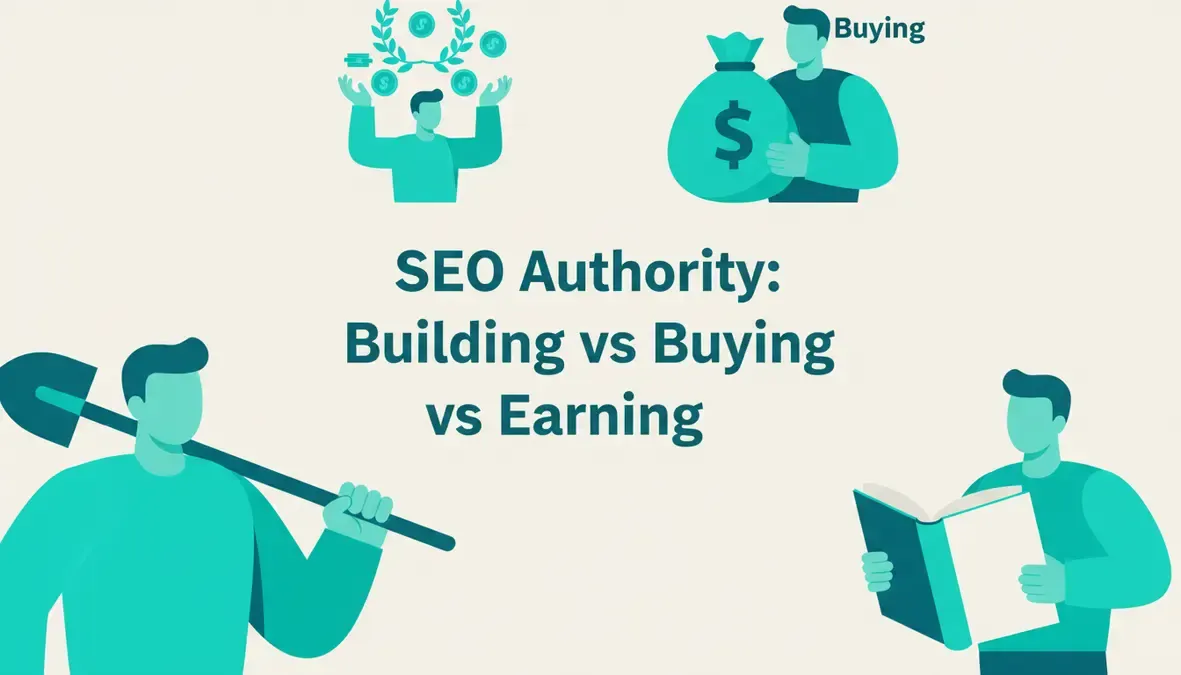
When it comes to SEO authority, you have three main paths to choose from. Each approach has its place, and the one you pick can make or break your search rankings. Whether you're building authority from the ground up, buying backlinks, or earning them through content, the stakes are high.
SEO authority isn't just about getting more links—it's about establishing your website as a trusted resource that search engines want to recommend. The difference between a site with strong authority and one without is dramatic. High-authority sites rank for competitive keywords, recover quickly from algorithm updates, and see consistent organic traffic growth.
This guide breaks down the three main approaches to SEO authority: building it organically through content and outreach, buying it through paid link placements, and earning it through exceptional content that naturally attracts links. You'll learn when each method makes sense, how to implement them safely, and which combination works best for your specific situation.
Understanding Your SEO Authority Options
SEO authority comes down to how search engines view your website's credibility and expertise. Google looks at factors like backlink quality, content depth, user engagement signals, and domain age to determine where your pages should rank in search results.

The three primary approaches to building SEO authority each serve different purposes and timelines. Building authority organically focuses on creating valuable content and earning links through outreach and relationship-building. This method takes time but creates sustainable, long-term results that search engines trust.
Buying authority involves purchasing backlinks from other websites, either through direct payments or link networks. While this can provide quick results, it carries significant risks if not done carefully. Search engines have sophisticated algorithms designed to detect and penalize artificial link schemes.
Earning authority happens when your content is so valuable that other websites naturally link to it without any prompting from you. This is the gold standard of SEO authority building, but it requires exceptional content and often takes months or years to generate significant results.
Why It Matters: The approach you choose affects not just your current rankings, but your website's long-term sustainability. Sites built on purchased links often see dramatic ranking drops during algorithm updates, while organically built authority tends to remain stable.
The Authority Building Landscape
Modern SEO authority building operates in a complex ecosystem where quality trumps quantity. A single link from a high-authority, relevant website can be worth more than dozens of low-quality links. Search engines have become increasingly sophisticated at evaluating link quality, context, and natural link patterns.
The backlink landscape has evolved dramatically over the past decade. What worked in 2015—mass directory submissions, article spinning, and link farms—now triggers penalties that can take years to recover from. Today's successful authority building requires a more nuanced approach that focuses on genuine value creation and relationship building.
Understanding your competition is crucial when choosing your authority building strategy. Sites in highly competitive niches often need a combination of all three approaches to compete effectively, while those in less competitive spaces might succeed with purely organic methods.
Comparing SEO Authority Methods
The three main approaches to SEO authority differ significantly in their implementation, timeline, costs, and risk profiles. Understanding these differences helps you make informed decisions about which methods to prioritize for your specific situation.
Comparison of SEO Authority Approaches
| Method | Timeline | Cost | Risk Level | Sustainability |
|---|---|---|---|---|
| Building Authority | 6-18 months | Medium | Low | High |
| Buying Authority | 1-3 months | High | High | Low |
| Earning Authority | 12-36 months | Low | Very Low | Very High |
Each method requires different resources and expertise. Building authority demands consistent content creation, outreach skills, and relationship management. Buying authority requires significant budget and the ability to identify quality link opportunities while avoiding penalties. Earning authority needs exceptional content creation skills and patience to see results.
The risk-reward profile varies dramatically between approaches. Organic building and earning methods carry minimal penalty risk but require substantial time investment. Purchased links can provide quick results but risk severe penalties if detected by search engines or if the linking sites lose their own authority.
Pro Tip: Most successful SEO strategies combine elements from all three approaches. The key is understanding which method to emphasize based on your timeline, budget, and risk tolerance.
When to Choose Building Authority
Building authority through organic methods works best when you have a long-term perspective and want sustainable results. This approach involves creating valuable content, conducting strategic outreach, and developing relationships with other websites in your industry.
The building approach excels in competitive niches where shortcuts are quickly detected and penalized. Industries like finance, health, and legal services benefit most from this method because search engines apply extra scrutiny to sites in these sectors.
Resource requirements for building authority include dedicated content creation, outreach tools, and staff time for relationship management. You'll need writers, outreach specialists, and potentially PR professionals to execute this strategy effectively.
When to Choose Buying Authority
Buying authority makes sense in specific situations where speed is critical and you have the budget to invest in high-quality link placements. This might include product launches, competitive battles, or situations where organic methods aren't generating results quickly enough.
The key to successful link purchasing is focusing on quality over quantity. High-authority, relevant websites that accept sponsored content or guest posts can provide valuable authority boosts when done correctly. The emphasis should be on sites that your target audience actually reads and trusts.
Budget considerations for buying authority can range from hundreds to thousands of dollars per month, depending on your industry and competition level. Quality links from authoritative sites often cost $500-$5000 per placement, making this approach resource-intensive.
When to Choose Earning Authority
Earning authority through exceptional content works best when you can create truly unique, valuable resources that naturally attract links. This approach requires the highest content quality standards but generates the most sustainable results.
The earning approach excels when you have unique data, research capabilities, or industry insights that others can't easily replicate. Companies with proprietary research, industry surveys, or innovative tools often succeed with this method.
Success with earning authority requires patience and consistency. You might publish exceptional content for months before it gains traction and starts attracting natural links. However, once the momentum builds, earned authority tends to compound over time.
Deep Dive: Building SEO Authority Organically
Building SEO authority organically involves a systematic approach to creating valuable content and earning links through legitimate outreach and relationship building. This method forms the foundation of most successful long-term SEO strategies.
The organic building process starts with comprehensive content creation that serves your target audience's needs. This isn't about creating content for search engines—it's about solving real problems and providing genuine value that other websites want to reference and link to.

Content quality becomes the cornerstone of organic authority building. Your content needs to be more comprehensive, more accurate, or more useful than what currently ranks for your target keywords. This often means creating longer-form content that covers topics in greater depth than competing resources.
Strategic Content Development
Successful organic authority building requires strategic content planning that identifies link-worthy topics before you start writing. The best content for earning links typically falls into several categories: original research, comprehensive guides, industry analysis, and useful tools or resources.
Original research content performs exceptionally well for earning links because it provides unique value that other sites can't replicate. Industry surveys, data analysis, and trend reports naturally attract citations from other websites looking to support their own content with credible sources.
Comprehensive guides work well when they genuinely improve upon existing resources. Your guide needs to be more complete, more current, or more actionable than what's already available. This requires significant research and often involves creating custom graphics, tools, or templates that enhance the user experience.
Expert Tip: The most linkable content often combines multiple content types. A comprehensive guide that includes original research, custom graphics, and downloadable resources tends to attract more links than content using only one approach.
Outreach and Relationship Building
Effective outreach transforms good content into link opportunities by connecting your resources with website owners who might find them valuable. The key is approaching outreach as relationship building rather than link begging.
Successful outreach starts with identifying websites that have linked to similar content in the past. Tools like Ahrefs and SEMrush can help you find sites that have linked to your competitors' content, giving you a starting point for your outreach efforts.
The outreach message itself should focus on the value you're providing rather than the link you want. Explain how your content improves upon or complements existing resources they've linked to, making it clear why their audience would benefit from your content.
Building Industry Relationships
Long-term authority building benefits enormously from genuine industry relationships. When you know other website owners, content creators, and industry influencers personally, earning links becomes much easier and more natural.
Industry relationships develop through consistent engagement, mutual value creation, and genuine interest in others' success. This might involve participating in industry forums, attending conferences, collaborating on content projects, or simply being helpful when others have questions or need resources.
The relationship-building approach takes time but creates compounding benefits. Once you're known and trusted in your industry, earning links becomes significantly easier because people already know the quality of your work and are more likely to reference it.
Deep Dive: Buying SEO Authority
Buying SEO authority involves purchasing backlinks through various paid methods, from sponsored content to guest post placements. While risky, this approach can be effective when executed carefully with a focus on quality and relevance.
The key to successful link purchasing is understanding the difference between legitimate paid placements and manipulative link schemes that violate search engine guidelines. Legitimate paid links often involve sponsored content, guest posting with disclosure, or advertising placements that happen to include links.
Quality assessment becomes crucial when buying authority because low-quality purchased links can harm your rankings more than help them. The linking site's authority, relevance, content quality, and link profile all factor into whether a purchased link will provide value or create problems.
Identifying Quality Link Opportunities
Quality link opportunities for purchase typically come from established websites with strong domain authority, relevant audiences, and editorial standards. These sites often accept sponsored content, guest posts, or other forms of paid placement that can include links to your website.
The evaluation process for potential link purchases should examine multiple factors: the site's organic traffic, backlink profile, content quality, audience engagement, and relevance to your industry. Sites that rely heavily on purchased links themselves or have declining traffic patterns should be avoided.
Pricing for quality link placements varies significantly based on the site's authority and your industry. Established websites with strong audiences often charge $1000-$5000 for sponsored content placements, while smaller niche sites might accept guest posts for $100-$500.
Key Takeaway: The most expensive links aren't always the best value. A relevant link from a smaller site with an engaged audience often provides better results than an expensive link from a high-authority site with no relevance to your business.
Risk Management Strategies
Managing the risks associated with buying authority requires careful planning, diversification, and ongoing monitoring. The goal is to create a natural-looking link profile that provides value while minimizing penalty risk.
Diversification becomes critical when purchasing links because search engines look for patterns that indicate manipulation. Varying your anchor text, linking to different pages on your site, and spacing out link acquisitions helps create a more natural-looking profile.
Disclosure and transparency can actually protect you when buying links. Many successful sites openly label sponsored content and paid placements while still receiving SEO value from these links. Search engines are more concerned with deceptive practices than disclosed paid placements.
Quality vs. Quantity Considerations
The quality vs. quantity debate in link purchasing strongly favors quality, especially as search engines become better at detecting low-quality link schemes. A few high-quality, relevant links typically provide better results than many low-quality ones.
Quality indicators for purchased links include editorial standards, content requirements, audience engagement, and natural link acquisition patterns. Sites that accept any content without review or have obvious link schemes should be avoided regardless of their stated authority metrics.
Investment allocation for link purchasing should prioritize the highest quality opportunities within your budget. It's often better to purchase fewer high-quality links than to spread your budget across many mediocre opportunities that might not provide lasting value.
Deep Dive: Earning SEO Authority Naturally
Earning SEO authority naturally represents the gold standard of link building—creating content so valuable that other websites link to it without any prompting or payment. This approach requires exceptional content quality but generates the most sustainable and valuable links.
The earning approach focuses on creating link magnets: content pieces that naturally attract citations because they provide unique value, solve important problems, or offer insights unavailable elsewhere. These might include original research, comprehensive resources, useful tools, or groundbreaking analysis.

Success with earning authority requires understanding what motivates other website owners to link to content. They link when content helps their audience, supports their arguments, provides credible sources, or offers resources their readers will find valuable.
Creating Link-Worthy Content
Link-worthy content typically exhibits several characteristics: uniqueness, comprehensiveness, utility, and credibility. Your content needs to offer something that doesn't exist elsewhere or improve significantly upon existing resources.
Uniqueness often comes from original research, proprietary data, or unique perspectives based on experience. Industry surveys, case studies, and data analysis naturally attract links because they provide information that other sites can't replicate.
Comprehensiveness means covering topics more thoroughly than competing resources. This might involve creating longer guides, including more examples, providing better explanations, or covering aspects that others have overlooked.
Utility focuses on practical value—content that helps people accomplish specific goals or solve particular problems. Tools, templates, checklists, and step-by-step guides often earn links because they provide immediate practical value.
Pro Tip: The best link-worthy content often combines multiple value propositions. A comprehensive guide that includes original research, practical tools, and unique insights tends to attract more links than content offering only one type of value.
Content Promotion Strategies
Even exceptional content needs promotion to reach its link-earning potential. The promotion process involves getting your content in front of people who might find it valuable enough to link to or share.
Social media promotion helps content gain initial visibility and engagement, which can lead to link opportunities. When content performs well on social platforms, it often catches the attention of website owners and content creators who might link to it.
Industry outreach involves sharing your content with relevant influencers, journalists, and website owners who cover related topics. This isn't asking for links—it's sharing valuable resources that might be useful for their audience or future content.
Email marketing to your existing audience can help content gain initial traction and shares, which increases its visibility and link-earning potential. Subscribers who find content valuable often share it within their own networks or reference it in their own content.
Measuring Earned Authority Success
Measuring success with earned authority requires tracking both immediate metrics and long-term compound effects. Initial metrics include content views, social shares, and early link acquisition, while long-term metrics focus on sustained link growth and authority improvements.
Link velocity tracking shows how quickly your content attracts new links over time. High-quality content often shows sustained link growth months or even years after publication as more people discover and reference it.
Referral traffic from earned links provides insight into link quality and relevance. Links that drive engaged traffic typically come from relevant, high-quality sources that provide lasting SEO value.
Domain authority improvements take time but represent the ultimate goal of earning authority naturally. As you consistently create link-worthy content, your overall domain authority should gradually increase, making it easier to rank for competitive keywords.
Why SEO Authority Matters for Your Business
SEO authority directly impacts your ability to compete in search results, especially for valuable commercial keywords. Sites with strong authority rank higher, recover faster from algorithm updates, and see more consistent organic traffic growth over time.
The business impact of SEO authority extends beyond search rankings to include brand credibility, industry recognition, and competitive advantages. High-authority sites are often seen as industry leaders, which can influence customer trust and purchasing decisions.

Authority also provides resilience against competitive threats and algorithm changes. When competitors try to outrank you or search engines update their algorithms, strong authority helps maintain your positions and recover more quickly from any temporary drops.
Revenue Impact of Strong Authority
Strong SEO authority translates directly into revenue through higher search rankings for commercial keywords. The difference between ranking #1 and #5 for a valuable keyword can mean thousands or millions in annual revenue, depending on your industry.
Authority also enables you to rank for a broader range of keywords, including long-tail variations that collectively drive significant traffic. High-authority sites often rank for hundreds or thousands of related keywords without specifically targeting them.
The compound effect of authority means that early investments in authority building pay dividends for years. Once established, authority makes it easier to rank new content, launch new products, and expand into related markets.
Why It Matters: SEO authority isn't just about search rankings—it's about building a sustainable competitive advantage that becomes harder for competitors to replicate over time.
Competitive Advantages
Strong SEO authority creates multiple competitive advantages beyond search rankings. High-authority sites often receive more media mentions, partnership opportunities, and industry recognition, which can lead to business opportunities beyond SEO.
Authority also provides negotiating power in industry relationships. When your site is seen as an authoritative source, other businesses are more likely to want to partner with you, guest post on your site, or collaborate on content projects.
The credibility that comes with SEO authority can influence customer behavior throughout the sales funnel. Prospects who find you through search are more likely to trust your expertise and consider your solutions when you rank prominently for industry keywords.
Long-term Business Value
SEO authority represents a long-term business asset that appreciates over time with proper maintenance. Unlike paid advertising that stops working when you stop paying, authority continues providing value as long as you maintain your content quality and link profile.
The asset value of SEO authority can significantly impact business valuations, especially for online businesses where organic traffic represents a major revenue source. Businesses with strong SEO authority often command higher multiples when sold.
Authority also provides strategic flexibility for business growth. Strong SEO authority makes it easier to launch new products, enter new markets, or pivot business models because you already have the search visibility and credibility needed to reach new audiences.
Common Questions About SEO Authority
What's the difference between domain authority and page authority?
Domain authority measures the overall strength and credibility of an entire website, while page authority focuses on the ranking potential of individual pages. Domain authority is calculated based on factors like the total number and quality of backlinks pointing to all pages on a domain, the age of the domain, and overall content quality across the site.
Page authority, on the other hand, evaluates specific pages based on their individual backlink profiles, content quality, user engagement signals, and relevance to target keywords. A single page can have high authority even if the overall domain authority is moderate, particularly if that page has attracted high-quality links and provides exceptional value.
Understanding this distinction helps in planning your SEO strategy. While building domain authority provides long-term benefits for all your content, focusing on page authority for specific high-value pages can deliver quicker results for important commercial keywords.
Both metrics work together to determine search rankings. Pages on high-authority domains have an advantage in rankings, but exceptional page-level authority can help content rank well even on newer or lower-authority domains.
How long does it take to build meaningful SEO authority?
Building meaningful SEO authority typically takes 6-18 months for noticeable improvements and 2-3 years for substantial authority in competitive niches. The timeline depends heavily on your industry competition, content quality, link acquisition rate, and starting point.
New websites start with zero authority and face the additional challenge of the "Google sandbox effect," where new domains often struggle to rank for competitive keywords regardless of content quality. This initial period can last 3-6 months before you start seeing significant organic traffic growth.
Established websites with some existing authority can see faster results when implementing authority-building strategies. Sites that already have some quality backlinks and decent content can often improve their authority within 6-12 months with consistent effort.
The compound nature of authority building means progress accelerates over time. The first few high-quality links are hardest to earn, but as your authority grows, earning additional links becomes easier because other sites are more likely to trust and reference authoritative sources.
Can you lose SEO authority, and how do you recover?
Yes, SEO authority can be lost through various factors including algorithm penalties, loss of backlinks, declining content quality, or technical issues. Recovery is possible but often requires significant time and effort depending on the cause of authority loss.
Algorithm penalties represent one of the most common causes of authority loss, particularly when sites are penalized for manipulative link schemes or low-quality content. Recovery from penalties requires identifying and addressing the root cause, which might involve disavowing bad links, improving content quality, or removing manipulative SEO tactics.
Natural link loss occurs when linking sites go offline, remove content, or change their link structure. While some link loss is normal, significant losses can impact authority. Monitoring your backlink profile and working to replace lost high-value links helps maintain authority levels.
Content decay can gradually erode authority when information becomes outdated, competitors create better resources, or user needs evolve. Regular content auditing and updates help maintain the relevance and value that originally earned links and authority.
How do you measure SEO authority accurately?
Measuring SEO authority requires tracking multiple metrics rather than relying on any single score. While tools like Moz's Domain Authority and Ahrefs' Domain Rating provide useful benchmarks, they're estimates rather than official Google metrics.
Backlink quality and quantity provide the most direct authority indicators. Track the number of referring domains, the authority of linking sites, the relevance of linking content, and the diversity of your link sources. Quality metrics matter more than quantity—100 links from high-authority, relevant sites typically provide more value than 1000 low-quality links.
Organic search performance offers practical authority measurement through keyword rankings, organic traffic growth, and ranking stability during algorithm updates. Sites with strong authority typically maintain rankings better during updates and recover faster from any temporary drops.
Competitive analysis helps contextualize your authority within your industry. Compare your backlink profiles, content quality, and search performance against top competitors to understand your relative authority position and identify improvement opportunities.
What's the biggest mistake people make with SEO authority?
The biggest mistake in SEO authority building is prioritizing quantity over quality in link acquisition. Many people focus on getting as many backlinks as possible rather than earning high-quality, relevant links that actually improve their authority and rankings.
This quantity-focused approach often leads to pursuing low-quality link opportunities like directory submissions, article spinning, or link exchanges that provide minimal value and may actually harm rankings. Search engines have become sophisticated at identifying these manipulative tactics.
Another common mistake is neglecting content quality while focusing entirely on link building. Authority requires both high-quality content and quality backlinks—you can't build sustainable authority with great content and no links, or with many links pointing to poor content.
Impatience represents another significant mistake, leading people to pursue risky shortcuts like buying low-quality links or participating in link schemes. Building real authority takes time, and attempts to accelerate the process artificially often backfire with penalties that set progress back months or years.
How does SEO authority affect local businesses differently?
Local businesses face unique authority-building challenges and opportunities compared to national or international companies. Local SEO authority heavily emphasizes geographic relevance, local citations, and community connections rather than just industry-wide recognition.
Geographic relevance becomes crucial for local authority, meaning links from local news sites, community organizations, and regional business directories often provide more value than higher-authority national sites with no local connection. A link from your city's newspaper might be more valuable than one from a national publication.
Local citations and directory listings play a larger role in local authority than they do for national SEO. Consistent NAP (Name, Address, Phone) information across local directories, review sites, and business listings helps establish local authority and improves local search rankings.
Community involvement and local partnerships offer natural authority-building opportunities that national businesses can't easily replicate. Sponsoring local events, participating in community organizations, or partnering with other local businesses can generate valuable local links and citations.
Final Thoughts
Building SEO authority requires choosing the right combination of organic building, strategic purchasing, and natural earning based on your timeline, budget, and risk tolerance. Most successful long-term strategies emphasize organic building and earning while using selective purchasing to accelerate results in competitive situations. Get started with RankLoop to develop an authority-building strategy that fits your specific business goals and market position. Ready to get started? Visit RankLoop to learn more.